
God can work through anyone
And other lessons from Genesis 25

Transcribed & edited for written clarity, from my sermon at Jubilee Episcopal Church on July 12, 2026. You can watch the video of it here, sermon starts about 20 minutes in. Also, as is so often the case, I am deeply grateful to the work of Working Preacher for their podcast and commentary, this week by Matthew Schlimm, which richly informed my sermon this week.
Genesis 25, NRSVUE:
19 These are the descendants of Isaac, Abraham’s son: Abraham was the father of Isaac, 20 and Isaac was forty years old when he married Rebekah, daughter of Bethuel the Aramean of Paddan-aram, sister of Laban the Aramean. 21 Isaac prayed to the Lord for his wife because she was barren, and the Lord granted his prayer, and his wife Rebekah conceived. 22 The children struggled together within her, and she said, “If it is to be this way, why do I live?”[c] So she went to inquire of the Lord. 23 And the Lord said to her,
“Two nations are in your womb,
and two peoples born of you shall be divided;
the one shall be stronger than the other;
the elder shall serve the younger.”24 When her time to give birth was at hand, there were twins in her womb. 25 The first came out red, all his body like a hairy mantle, so they named him Esau. 26 Afterward his brother came out, with his hand gripping Esau’s heel, so he was named Jacob.[d]Isaac was sixty years old when she bore them.
27 When the boys grew up, Esau was a skillful hunter, a man of the field, while Jacob was a quiet man, living in tents. 28 Isaac loved Esau because he was fond of game, but Rebekah loved Jacob.
29 Once when Jacob was cooking a stew, Esau came in from the field, and he was famished. 30 Esau said to Jacob, “Let me eat some of that red stuff, for I am famished!” (Therefore he was called Edom.[e]) 31 Jacob said, “First sell me your birthright.” 32 Esau said, “I am about to die; of what use is a birthright to me?” 33 Jacob said, “Swear to me first.” So he swore to him and sold his birthright to Jacob. 34 Then Jacob gave Esau bread and lentil stew, and he ate and drank and rose and went his way. Thus Esau despised his birthright.
I love Rebekah in Genesis.
She and Isaac, like Isaac’s parents, are facing fertility grief. And one of the first things that I really want us to pay attention to in this story is this: God cares about our reproductive lives.
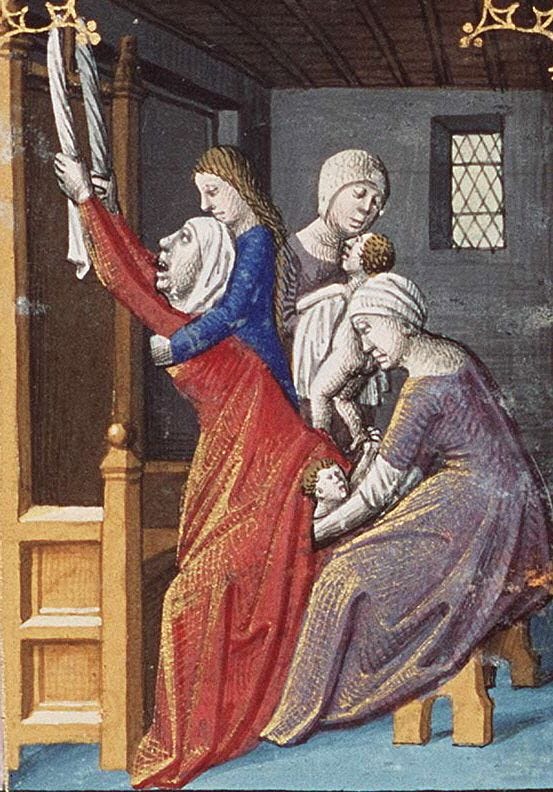
If we read this and say, “oh, infertility is just a matter of praying to God and God will fix it, and if you haven’t asked enough, then clearly you aren’t faithful or whatever,” we’ve missed the point. We’ve missed the point that God pays particular attention. to what is heavy for us. God cares deeply about what happens in our incarnate, our embodied, our soul-body lives.
And also? Rebekah is just so incredibly relatable. She has prayed for this pregnancy, and finally, it comes, and she laments unto God: “if it is to be this way, then why then do I live?” It reminds me of those memes where the mom at the end of the day, lying on the floor, or screaming in the pillow, with the caption: me after spending a day with the children I prayed to God for.
And part of what’s relatable about it is we see, even in this ancient Iron Age story, a glimpse of what pregnancy and postpartum mental health looks like. And it’s hard. Rebekah’s cry to God, her anger and sorrow that she expresses directly to the God who gave her this miracle that she asked for is not antithetical to her faith. God does not punish her or demean her faithfulness or her journey for being honest with God.
We can be honest with God about the things we struggle with.
God desires that honesty from us. God rewards that honesty from us, and it isn’t a sign of lack of faith. It’s actually the ultimate gesture of faith. It is saying God is big enough and holy enough to hold all that we hold, and to actually carry it for us.
And in a rare and beautiful moment, after Rebecca speaks directly to God, God answers her. God tells her: there are 2 nations wrestling within you.
And here is where we hear both this story, that is — the story of this one family. But we also ought to hear the story of scripture as we have received it. To make a very long and complicated story, rather short, part of what is always at play, in the Hebrew Bible, or the Old Testament, is when these stories were written down. Now, these stories are old. They are very, very old, and they were orally passed down. And in a culture as literate as ours, we are prone to hear that and say, well, that must have been a game of telephone, right? That story must have gotten distorted over the time, over the years.
But you have to remember, people lived their whole lives without being able to read or write. Oral tradition was beautifully preserved. And these stories were written down in part, but they were not codified. They were not all put together in the version that we have received him, until the people of God, the Israelites, were forcibly exiled from the land God had promised them. And suddenly, they were faced with a reality of that terrible question, Who are we?
Who are we when we become a people without a land, when we are people of the land?
Who are we when we are people of God when God has said that we have not followed God’s covenant?
Once the people of the land were forcibly stripped from that land, they were afraid of losing their identity, so they began to really focus on writing down these stories. So even as we hear the story in Genesis, which is way before even the notion of being the people of Israel, before even the name Israel emerges, we are still hearing a story that is colored by the people of Israel in exile.
And this is particularly significant, because, at a guess, I doubt you caught why Esau is called Edom. Well, here’s the thing. So Esau and Jacob are siblings. And Esau, as we heard in the text, will come to be called Edom. Well, fast forward many, many generations. And the Edomites are a people living in the promised land alongside the Israelites. All of scripture in many ways is a sibling rivalry. And the Edomites rejoiced when the Israelites were forced into exile.
So this whole story of Jacob and Esau in many ways is kind of like a villain origin story. It’s kind of like, those people who laughed at us?? Well, it goes all the way back to Esau.
But here’s what’s interesting. Jacob is the ancestor of the Israelites. Jacob is the ancestor who, spoiler alert, in a few chapters, is going to wrestle with God and be given a new name: Israel. “One who strives with God.” And Jacob/Israel is going to have a lot of children, but they’re 12 children who we particularly pay attention to because they become the 12 tribes of Israel. Jacob is the chosen ancestor of the lineage of Jesus.
But … Jacob is not exactly a good person. It is very tempting to see these stories in scripture, particularly of these sacred ancestors as holy and universally perfect. But there’s only one perfect person in the Bible, and his name is Jesus.
It’s almost like the narrator is turning up the volume on Jacob’s flaws, sort of like the camera and Abbott Elementary or The Office panning over being like, you see these guys? Do you see them? Even you can be beloved by God if these guys can, right?
Jacob is not chosen because he’s better than Esau. He’s chosen because he’s been given a specific job to do. That’s it. He’s been given a specific job, a specific vocation.
And I want us to be clear about that, because there is danger in writing off bad behavior, especially in men in the Bible, and saying, well, it’s fine that they behave badly, because …God! Writing them off like that doesn’t actually wrestle with Scripture authentically. And it creates cultures of abuse where we write off abusive behavior, particularly of men of God, and say, well, it’s fine, because God!
And that’s not, in fact, what God is doing in this text, nor, nor is it what the people of God are doing, in telling this hero/villain origin story.
After Esau and Jacob are born, after they grow up, we see a scene between two rival brothers. Jacob is cooking that beautiful red stew, and Esau comes in from the field, and is like, I’m absolutely famished. Give it to me right now. Esau was out hunting, so he could have been out for days or weeks. So he really could be close to starvation.
So there’s 2 things I notice. And these 2 things are juxtapositions. These two things are almost oppositional to one another. They are almost twins wrestling in a womb. And we have to listen to both of these, to hear how God can speak through and in and in spite of these juxtapositions.
Here is my first observation: Jacob is cunning. He is clever. He is deceptive. My Old Testament professor, Ellen Davis would always say, “Jacob is a trickster!” That does not make him morally superior. But it does make him a survivor. And when you consider how much the people of God had to survive, it’s kind of no wonder to me that Jacob is one of these heroes of the faith. His cunning made him a survivor. And that doesn’t mean that we should all be cunning and clever and deceitful and deceptive … but I do think what it can teach us today is being faithful is not the same thing as being a doormat. Let’s not misinterpret following the love of God as just laying down and taking everything that is thrown at us.
As that great prophet Taylor Swift says, “never be so kind, you forget to be clever.”
The second thing that I really notice is Esau, Edom, the enemy ancestor is actually the victim of Jacob in this story. Now, you may hear this and think, wow, Esau is a little impulsive. He’s a little silly. Why did he sell his birthright for a cup of stew? Little context, birthright is inheritance. And as the firstborn, Esau/Edom would have received double what Jacob would have received. I know that this, like, negotiation of birthright sounds strange to us today, because it’s like, why couldn’t you just take that back? It sounds like an idea, not a product.
But he couldn’t. And the reason he gives it away is because Esau is likely famished, potentially in great danger. And Jacob refuses to offer him hospitality. Whereas Jacob’s God, the God of Israel, over and over and over and over in scripture, commands the people of God to offer hospitality. This is what Jacob’s grandfather, Abraham, did, to those strangers who appeared. This is what will happen all throughout Scripture to come. So we should pay attention to the fact that Jacob does not feed someone who is hungry. Instead, he takes advantage of Esau/Edom and says, oh, you’re hungry? Give me your inheritance and then I’ll give you something to eat.
Even though Jacob is a hero of the faith, the heroic ancestor, the people who are descended from him are still willing to tell the truth of who he was. They are not glossing over the ugly parts of his character or the unsavory parts of his history. They trust that God is big enough to still be worshiped, even when God’s people are deeply flawed. And they also trust that we can hear the complexity of this history and receive it.
I wonder what our world would look like if we were as willing as the people of Israel to be that honest about the ancestors whom we laud and honor.
I should also say that there will be consequences for Jacob refusing to offer Esau hospitality. But for more on that? You’ll have to come back next week.
So there are a few things, now that we have really wandered into this strange and beautiful wilderness story of Genesis that I want to leave us with:
First: even though the stories of Genesis may not be the sort of first ones we reach for when we are struggling, they are so rich. They offer so much comfort for us today. Stories of sibling rivalry, of painful parental favoritism, of postpartum anguish, of miscarriage, of infertility — all of these are not stories that are new to God. All of this is part of our story as the people of God. And God does not neglect or ignore our grief. God is present to all of our stories.
Second: God can work through anyone. Even Jacob, even Esau, God can work through absolutely anyone. It is one of the most scandalous and offensive things in scripture. And here’s the other thing even more complicated about that God working through someone, including us, does not automatically make them the good guy, nor other people, the bad guys. Because here is the most complex truth of all: even our enemies are beloved children of God.
And that is something worth wrestling with. Amen.

"God can work through anyone" is a bit tricky for me. I actually believe it, but it's also what my MAGA friends say when I ask why they support a clearly broken man as president. "God can work through anyone," they say. Which doesn't answer my question, which is something like, "Sure God can work through anyone, but you could've voted for other conservative candidates who are more whole people and who might actually have gotten you better results. Why the fascination with this guy?" How do God's ability and our responsibility relate?
I'm not really a Swiftie but I love that you quoted the one TS song I know fully and love. Thank you for offering this insight on the Genesis today. I imagine many went for the Seed and Sower, but I love the way you open up the beauty and pain of the text as we start the journey of God’s flawed people.