
Reflections before our 5th Annual Pride Eucharist
It's special, but it's also very normal - and I think that kinda shocks people?

Sometimes people reach out to ask me for our “Pride liturgy.” (Forgive me if this is too inside baseball — this means: other clergy ask me for a copy of my plan for worship that we use for our pride-themed worship).
This is a lovely and good request, but I always have this response:
I don’t have one.
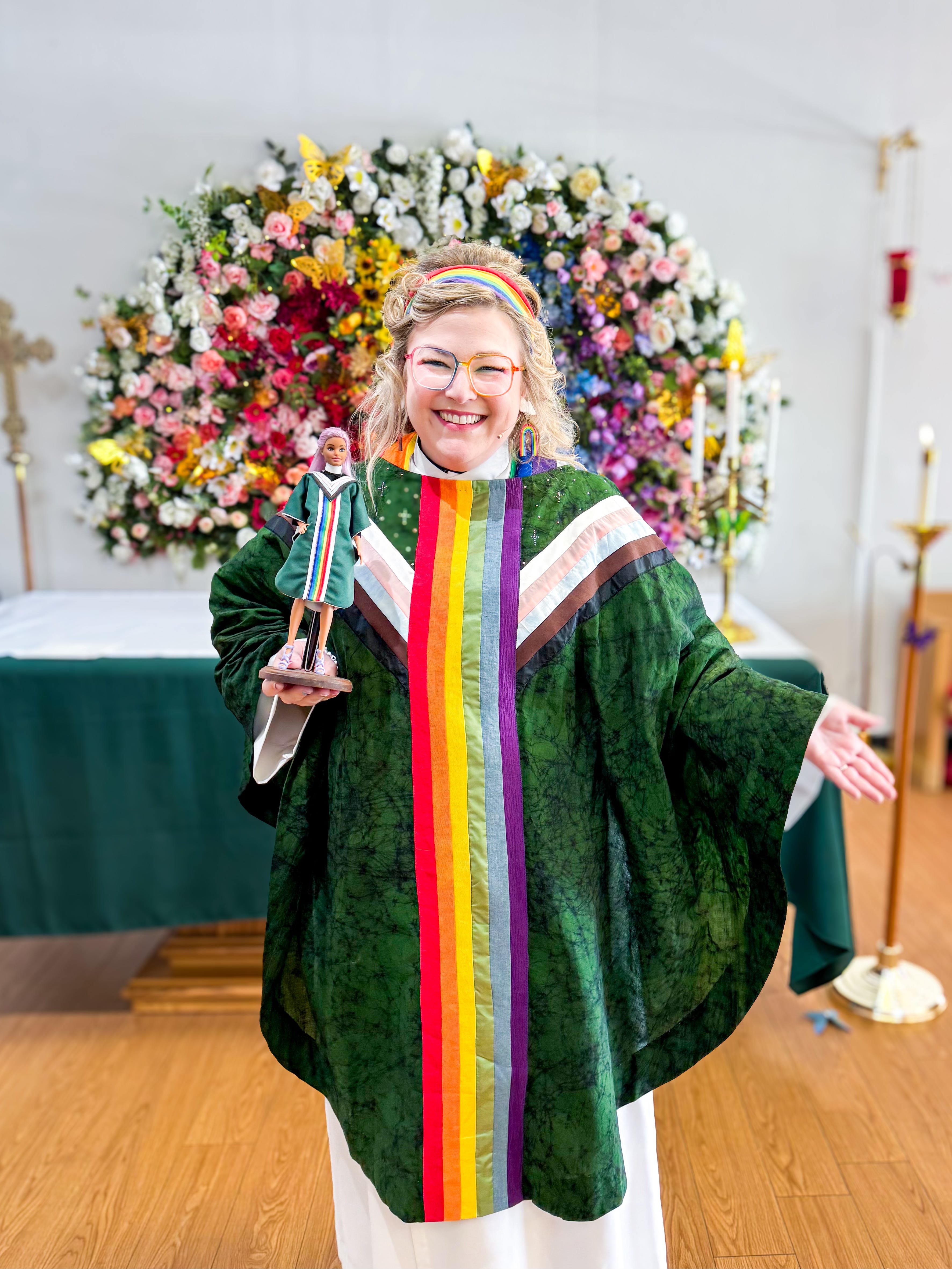
Our Pride Eucharist at Jubilee is this coming Sunday, June 7th. And in many ways it is “just another normal Sunday.”
The readings are not exceptional; they are the same readings we would hear if it wasn’t Pride - Proper 5, Year A, RCL, Track 1, if ya fancy. The Eucharistic prayer is not especially composed for this service (we’re doing EOW 3 this year, but we’ve done Prayer A most years) because we are making the point that the same prayers we pray for funerals and weddings and ordinary Sundays are already, in and of themselves, in inclusive of all God’s children.1
Our colors are green, per the order of the season, and we have rainbow accents to draw this out -- but it’s not really that different from even big austere churches who use shades of yellow and gold to convey white as the liturgical color.
Again, the point we’re making is this: YES, we shine bright, and we are making a bold welcome ... but this welcome should just be normal.
I love a well-thought-out liturgical experiment, sometimes. I’m way more liturgically orthodox than most people who say disparaging things about my sparkly shoes or whatever might realize. The Catholic girlie who never missed Mass is still very strong in me! Not to mention my own neurodivergence deeply needing a predictable pattern to be able to worship with breath and space. But I’ve been to other pride-themed services that did cool, new things, and I liked them. That is a holy and worthwhile thing to explore.
And. I find the usual things will do just fine when we’re doing a usual thing — expressing God’s incandescent love — and the point is more potent for me when the words we pray are basically the same as they were on Christmas Eve or a random Sunday in Lent. It is actually extremely normal to pray to God as a queer person, and to know God loves me. Our worship can reflect this normality.
I also hear this all the time from my congregation: “Jubilee was the first church -- first place, really -- where we just felt normal.”
I wish and long for this to be true in so many other places, and I cherish how we are showing other churches that this kind of mundane acceptance is possible. Because it makes getting back to the interesting, riveting, difficult, and beautiful work of figuring out of how to follow Jesus Christ more possible. I like to call this “Chapter 2 thinking.” Once you get past the inflammatory fights — or, better yet, if you can bypass them entirely — you get to the actual juicy stuff of being disciples of Jesus Christ in all our particularities and authenticity as the Body of Christ.
Of course, this is a gift. I grew up hearing my parents, imperfectly but clearly, telling me that no matter what we heard in church, “gay people are just the same as us and we love them.” My dad was the biggest champion in me going to a women’s college because he knew it would be a safe place for queer folks and, well, he had an inkling.
I am so blessed, truly.
And, I also know that I am not alone in this. So many queer folks are weary of deconstruction arguments and un-clobbering not because its’ not worthwhile (it VERY MUCH is) but because … we do also have other interests, other questions, and other things to talk about. Sometimes it’s nice for our reality to just be a given and not a talking point. Almost like, that’s what life after heteronormativity is unraveled can be. Also? We’re raising a bunch of kids at our church. Normalizing all kinds of family structures and the love people can share means this won’t be the thing they have to unpack in therapy later. They’ll have other stuff, but for now? Blended families, interracial families, queer families, all of God’s children — this is just … church.
It’s beautiful.
And this year, we had to pick our Pride Eucharist Sunday out of a slim selection due to a robust calendar with bishop visits and staff transitions. So June 7th emerged as the best of the slim pickings, and I knew I would just do my best with whatever Scriptures we were assigned that day.
It is, in fact, possible to bring a queer hermeneutic to any Scripture -- just as it is possible to bring a feminist hermeneutic, or Womanist hermeneutic, or liberation theology hermeneutic. “Hermeneutic” is our posh word in academia to mean “the lens we use to read something.” Everybody has a hermeneutic. Saying “the Bible must be read literally” IS a lens, a hermeneutic. So saying, “it is possible to bring a queer hermeneutic to any Scripture” is really just saying -- anything in the Bible can be read complexly, with capacious room for God to speak, and to hear a word of love and grace particularly for LGBTQIA+ folks. So I knew whatever the texts were, I could make this work, even if it took some creative writing and ponderous prayer.
But then! But then! The reading this Sunday is Genesis 12:1 - 9. And in Genesis 12, we hear God calling Abram, and transitively, his wife Sarai, to follow an unexpected call of God -- to leave the only homeland they have ever known, and journey far, on the promise they will be parents of a great nation. Except, of course, they have no children and have been trying to conceive and give birth for some time.
Not exactly a “woohoo, Pride!” text on the outside. But in this promise God offers, God says something utterly profound: “I will bless you, and you will be a blessing.”
If this is tickling a little memory for you, GOOD. Because over 10 years ago, the General Convention of the Episcopal Church, published an updated marriage liturgy that speaks to a more gender-inclusive vision of this sacramental rite. It is not “just” the liturgy with “male and female” scratched out, but a robustly thoughtful, 150+ page long theological document ABOUT marriage and why we made this move as a denomination (not unlike the Pope’s encyclicals, if that’s a new vocab word for you from recent news).
And the title of this piece?
“I will Bless you, and you will be a Blessing.”
Turns out, God was adding a little glimmer to our slim-pickin’ Pride Eucharist date after all.
I will share more about this in my sermon this Sunday, but I wanted to leave you with this insight as I think it sets the stage for us to think, prayerfully and earnestly, about God’s blessing of us to be blessings.
In this monumental Episcopal document about marriage, blessing, and why a church ought to sacramentally honor the dignity already present in covenanted partnerships, the Standing Commission on Liturgy says this:
”Many in the Episcopal Church and other Christian communions believe that the celebration and blessing of the covenantal commitment of a same-sex couple also belongs in the Church’s work of offering outward and visible signs of God’s grace. While “blessing” exhibits a multifaceted meaning, it always originates in God, which the Church rightly and daily acknowledges: “We bless you for our creation, preservation, and all the blessings of this life; but above all for your immeasurable love in the redemption of the world by our Lord Jesus Christ; for the means of grace, and for the hope of glory.”
The Church participates in this fundamental, divine blessing in three related ways:
thanking God for God’s goodness and favor;
seeking God’s continued favor and grace so that we may manifest more fully that gratitude in our lives;
and receiving power from the Holy Spirit to bear witness to that grace in the world.
This threefold character of blessing acknowledges what is already present, God’s grace, but it does something more as well: it establishes a new reality.”
This just lands so deeply with all I think we are doing in our Pride Eucharist; the reality is, and has always been, and always will be that queer people exist and are made in the image of God, and worship in Christian communities all over the world. We do not “need” a special service to be loved. But when a church carves out a particular time and space to proclaim blessing, this transforms us because it invites all of us -- persecuted and persecutor, queer and not, hopeful and skeptic -- to be blessed by what God has been doing despite all these powers who oppress in the name of God. It does what liturgy does best: makes us stand still in space and time and see what God, who is bigger than space and time, is doing in us, around us, and through us. Not as some generalist experience, but with particularity. Even as this particularity is universal in its scandalous, powerful, consuming love.

Ok not to get, like, TOO in the weeds here, but we DO have custom prayers of the people. As we do every Sunday. I do share those for whoever asks, and the music selections have always included Testify to Love which, this year, is particularly delicious! So it’s not that we don’t have a special liturgy? But it’s not any more special than anything else we do for any other liturgical occasion, if that makes sense.
Amen, amen, amen! Thank you, dear heart. It’s pride weekend here in Northfield too. Grateful to be united with you and yours in the Eucharist, the queerest of all sacraments. ❤️
Great reflection as someone who is also queer, a woman, and shows up to church fabulously dressed but prefers more traditional liturgy. And I liked the mention of the praise song Testify to Love in your notes at the end. I grew up with the Wynonna Judd version of that song as it was featured in a certain very-tearjerking episode of Touched By An Angel, my favorite TV show of all time. Wynonna has always been an ally to the LGBT community and Touched By An Angel is often protrayed as conservative and traditionalist but it actually has a lot of progressive themes. And I noticed that a lot of the quirks and characteristics the angels had on the show were basically the exact same ones I had as an autistic person so I found it very comforting and empowering to see common characteristics associated with my neurodivergence associated with heavenly beings. I also found it to be queer coded to as the angels are basically aroaces as they don't marry and they take the form of a specific gender when they present as human meaning that they are basically trans.