
Why are we here?
A Pride Worship Service Sermon for Tyler, Texas at St. Clare's Episcopal Church

When I was in college I had this professor whom I just adored; her name is Jane, Jane Crosthwaite. And Jane, like me, was from North Carolina, and, like me, we found ourselves deep in the hills and mountains of Western Massachusetts, where the snow was feet thick on the ground for months at a time.
And Jane was a professor of religion — but not probably like the image of “religion” you might conjure as we sit here, in the sweltering buckle of the Bible Belt. No, Mount Holyoke is a college famed for being the first women’s college in the United States with progressive values and a diverse student body.
So I was sometimes a bit of an outlier being an actual Bible-believing Christian in a class full of people reading the Bible.
It was a wonderful experience, truly, to be surrounded by people who were willing to dissect and dismantle the text as a work of literary genius. It gave me permission to ask big questions and, actually, being surrounded by people who were either free of Bible Belt baggage or just willing to ask questions my youth group couldn’t have dreamed of … well, this environment was what made me just fall in love with the Bible. I got to read it as a bunch of wild and bizarre and beautiful stories with people who were encountering these stories for the first time.
And Jane embodied the irreverent reverence of this space.
She would wear her hair in tight, white curls; always had a stack of rings on her fingers and necklaces over her Ann Taylor or Land’s End turtlenecks and blazer combos; and her accent had not ceded one inch to the Massachusetts winter.
But in her southern drawl and sweet demeanor? She swore like a sailor.
I mean I have never heard anyone talk about religious history with so much … color.
And one day, peering at us over her reading glasses, she asked: “what is religion?”
I’m sure I bumbled some kind of answer. I’m sure my peers did, too. But we could all tell from her piercing, Steel Magnolia stare … we had not offered the correct answer.
And so she finally said:
“Religion is trying to answer the question of: why the <redacted> are we here?!”
I think about that all the time.
Because you might have asked yourself a similar question. If you’re here tonight, in Tyler, Texas, for a Pride Eucharist, I have no doubt that you have at least once wondered: why am I here?
Why did God make us?
You might think that the Bible would begin with this question. And, in a way, it does — and we heard that beginning tonight. The very first words on the first page of the Bible: Genesis 1. When God began to create the heavens and the earth …
Did you notice? Genesis doesn’t actually begin with a reason. God as narrator does not walk to center stage, tap the mic, and say:
and now, for my next act, I will explain why I am making the most intricate and complex ecosystems in a galaxy full of burning balls of fire …
…No. We don’t get neat explanations. We don’t get an explanation at all, really.
We get a love story.
We get the intricate, wild details of God making life and falling madly in love with that life, as all creators, as all parents do — tenderly, fondly, amazed and delighted.
God didn’t need to make the heavens and the earth or the creeping creatures or the birds of the sky, God didn’t need to make you, or me; God did not need to make the deepest blackness of the night or the most blinding brightness of the day, God did not need to make the marshlands, or the sacred liminality of twilight — God wanted to.
God desired to create.
And this matters. This matters because we do not exist to fulfill some hunger, or anger, or need for vengeance, or emptiness. God is wildly creative. God is passionately loving. God saw the deep and said: what if there was more?
And God saw you and said: what if there was more?
God saw the love that can exist between people — a natural extension of God’s own deep and powerful love within Godself — and God said: what if there was more?
And then — bless our human hearts — some of us saw the more, the too much-ness, the too wild to fit in-ness, and dared to say: but wouldn’t it be easier if we were small? I think God wants you smaller.
Nah, babes. Nah.
God didn’t dream up the aurora borealis, and photosynthesis, and the needles of pine trees, and the way babies giggle, just to decide we should cram ourselves into something small and sad and shameful. God does not look at you and see lack. God looks at you and sees all that you can be, and all that you have been, and God loves you.
Because our God is a good and abundant God.
God made the ends of a spectrum in night and day, God also wove the most beautiful, colorful skies at twilight and dawn, when the darkness and the light swirl and dance into something that is neither here nor there but in its moreness, in its too-muchness somehow too beautiful to describe.
So, to you, my siblings in Christ: in all your rainbow brightness and darkness, you who exist outside the norms of a world that preaches smallness instead of receiving the abundance of God, you who have always known you were different and you who are newly wondering, you who blend in and you who will always stick out, you who wonder daily how to keep living in Texas and you who say you will pull this state’s earth out of cold cowboy boots … I want you to hear clearly from me: the fullness of who you are is a blessing. The fullness of who you are is a reflection of God’s creativity that echoes back to the very beginning and will carry us all the way home.
You are made in God’s infinite, tender, wily creativity.
God is a ridiculous romantic. And you are made in the image of God, out of love, for love. For a love that is more.
Because that is why God made you. Full stop. For and out of love.
This is why Jesus tells us love is the greatest commandment, because love is the greatest origin the world has ever known, love is our first and final end, love is the reason. And I’m not saying love is always easy — but it is binding.
To the core of the earth and to the farthest reaches of our unexplored galaxy, love is what threads us together and to God.
And nothing, not not death or life, not angels or rulers, not present things or future things, not powers or height or depth, or anything else is going to take God’s love from you, or take you away from this love.
And that is good news, good people of God.
Because love?
Love is why we are here.
Amen.
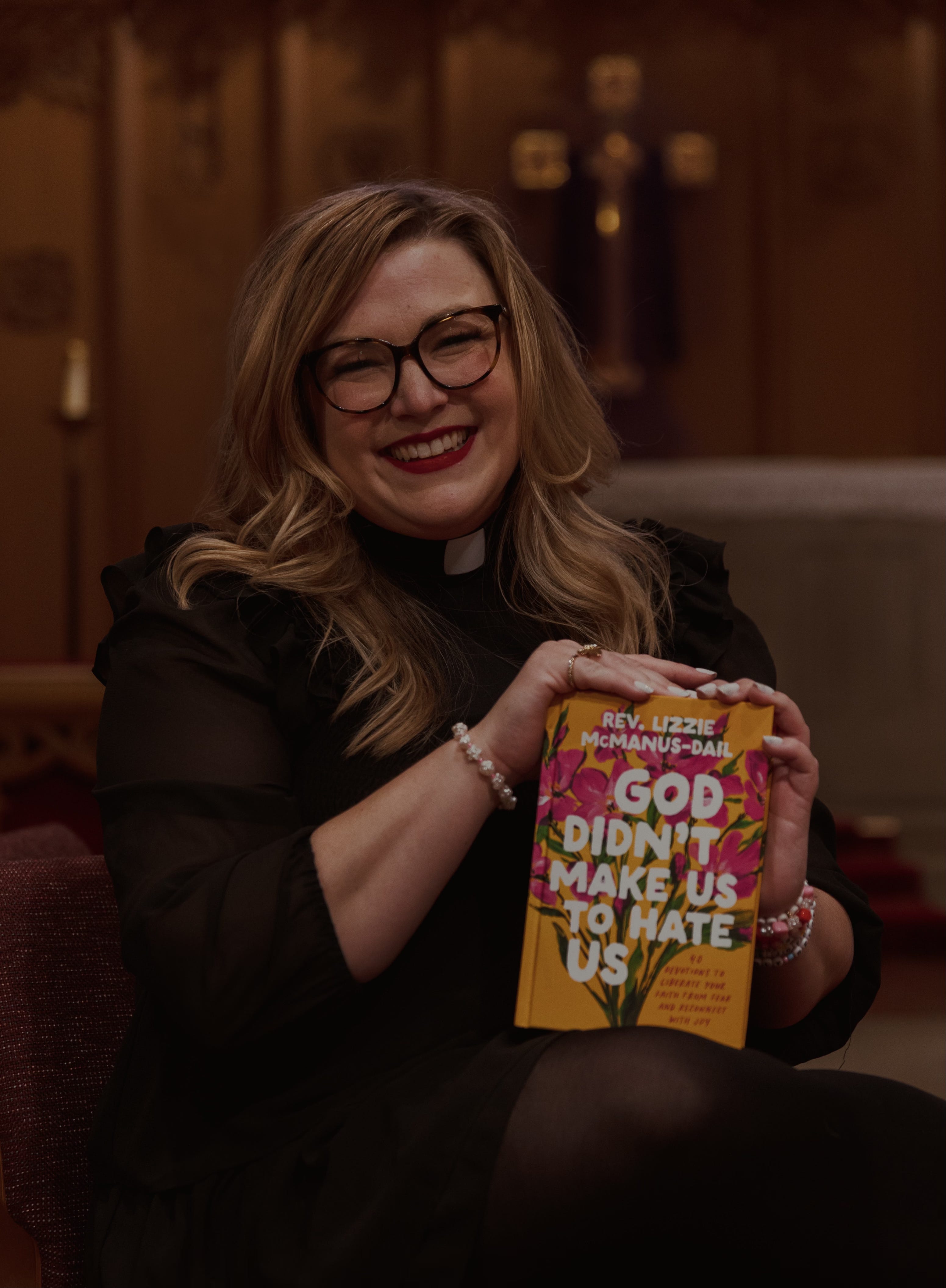
If you love this post, I really really promise you would love my book, God Didn’t Make Us to Hate Us, which is available in print, eBook, and audiobook format everywhere.
Yas! So beautiful to read this as a celebration of love and to feel the abundance of life that god desired through these words.